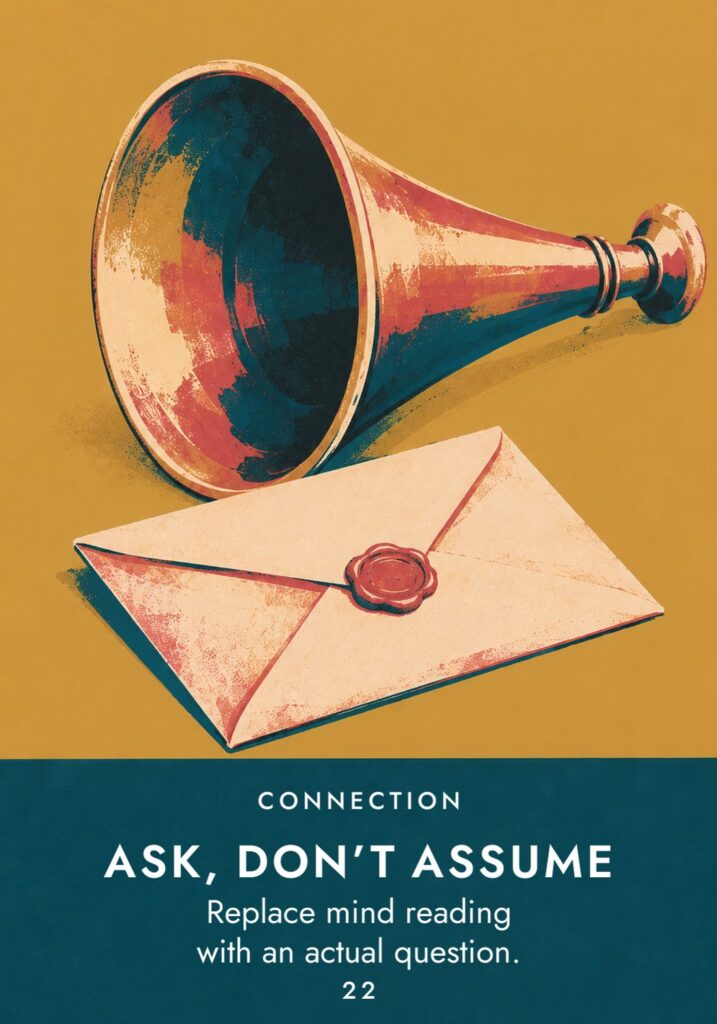
What Ask, Don't Assume means
This is the deck's plainest answer to the hidden-feelings market. No draw can tell you what another person thinks. You can know your own experience, observe behavior, remember what has been said, and sometimes ask. Attachment anxiety makes ambiguity feel unbearable, and avoidance makes direct conversation feel dangerous. Neither discomfort makes a guess more accurate. Climb the evidence ladder. What do I know? What am I inferring? What do I need to ask?
What do you actually know? That is the whole of Ask, Don't Assume, and the person who draws it has been running a theory instead. They know why their partner went quiet. They know what the ex meant by the birthday text. They have a complete account of someone else's inner life, built from tone and timing and a single overheard phone call, and they have not asked a single question. I read the card as the deck's plainest instruction, and also its most resisted one. The person is nearly every time more comfortable with the theory than with the question, because the theory can be revised privately and the question cannot. A question hands the other person the pen. The card says that is the point.
In shadow, this becomes "they pulled away because they secretly love me." Or demanding a certainty the other person does not have. The first is the romance of the hidden reason, where every withdrawal is read as a sign of depth and the person stays in a relationship with their own interpretation long after the actual person has stopped contributing to it. The second looks like courage and is a different kind of avoidance. The person asks, which is good, and then refuses any answer that is not final. "I don't know yet" gets treated as a dodge. Sometimes it is. Often it is the truth, and insisting it be otherwise turns a question into an interrogation.
I can ask the question instead of writing the answer.
When Ask, Don't Assume appears in a reading
In a reading, Ask, Don't Assume asks me to find out what the person has concluded and what the conclusion is resting on. I ask them to tell me the thing they are sure of, and then I ask what the other person actually said. Not implied. Said. The gap is usually the whole reading. "She's losing interest" is resting on two shorter texts and a cancelled Sunday, and the person has not asked about the Sunday. I listen for the fear under the theory, because the theory usually protects the person from a question whose answer they are bracing for.
My practice with the card is to write the assumption down and then rewrite it beginning with "Could you tell me." The grammar does most of the work. "He doesn't care about this trip" becomes "Could you tell me how you're feeling about the trip?" and the second version has an answer the first one did not. Then I decide whether I will ask, and when, and I hold myself to it. If I decide not to ask, I write down why, in plain words, and I read that sentence. Half the time the reason is that I would rather keep the theory than risk the answer, which tells me what the theory is for.
Beside Mixed Signals, I read the pair as the answer to the puzzle: the signals are inconsistent, and the next move is a question, not a better decoder. Where I keep Ask, Don't Assume distinct from Know Their World is that this card is about one specific assumption that needs testing, and that one is about ongoing curiosity, the habit of asking even when nothing is wrong. People often draw this card in a crisis and that one in a calm, and both are pointing at the same empty space where a question should be.
One small honest step
Write down one assumption you have been treating as fact, underline the part you actually know, and leave the rest unclaimed until you have more information.
Ask, Don't Assume in the You, Me, Us Spread
The Second Question guidebook’s three-card love reading is You, Me, Us, the classic layout with the positions changed so that none of them asks for mind reading. The first card is what I bring, the second is what their behavior has actually shown so far, and the third is what the dynamic needs for its next honest step. In each position this card tends to say:
- What I Bring. As What I Bring, the card says you have arrived with a theory about this person already in hand, and the theory is doing the work that a question should be doing.
- What Their Behavior Shows. As What Their Behavior Shows, it asks you to list what they have actually said and done, separately from what you have inferred, and to be honest about which column the conclusion came from.
- What the Dynamic Needs. As What the Dynamic Needs, it points to one direct question as the step that would replace guessing with information, and to the willingness to hear "I don't know yet" as an answer.
Journal prompts
- What conclusion am I treating as fact without any direct evidence?
- What answer am I afraid of, and could I survive hearing it?