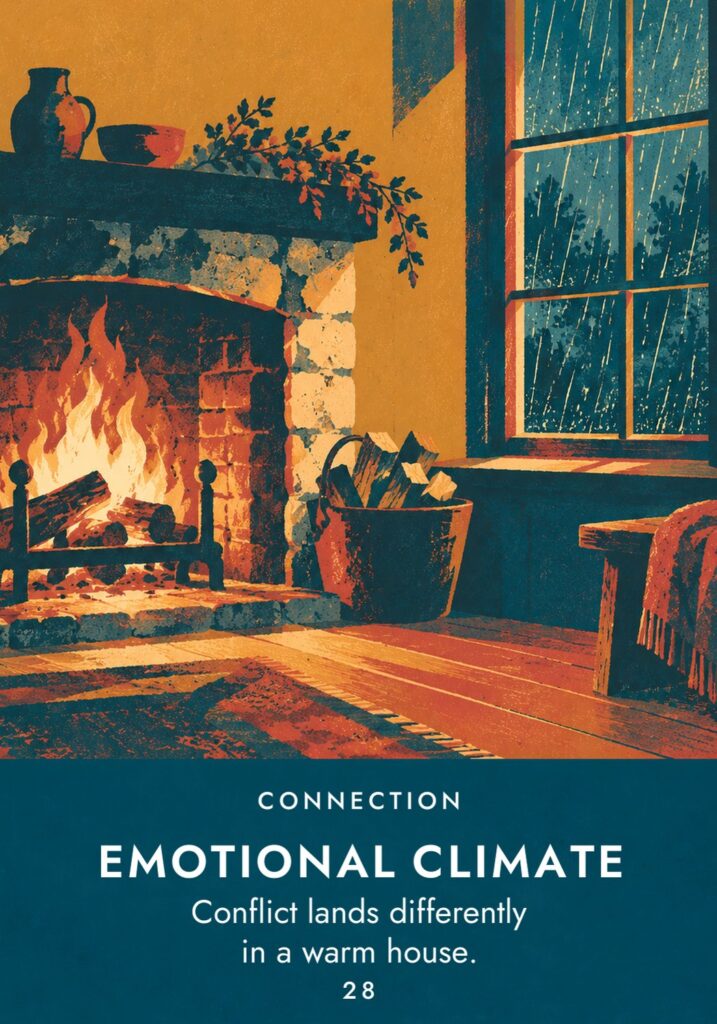
What Emotional Climate means
Researchers who filmed couples in conflict found that the stable, satisfied ones kept their good moments well ahead of the bad ones, roughly five to one. Treat that as a picture, not a quota. You cannot cancel one cruel remark with five compliments. What the picture shows is that conflict lands differently inside a relationship with affection, goodwill, appreciation, and play. A hard conversation in a warm house is survivable. In a cold one, it becomes the whole weather. Ask about the climate, not today's storm.
Emotional Climate comes up for someone who keeps describing the fights. The fight about the holidays, the fight about money, the fight on the drive home. They want to know how to fix the fights, and the card is less interested in the fights than in the weather they happen inside. I read it as a question about the ordinary hours. Not the Saturday argument, the Tuesday evening with nothing wrong. Is there warmth in it, appreciation said out loud, a joke that lands, a minute of undistracted attention? When those are present, a fight is a storm in a climate that can absorb it. When they are absent, the same fight is the entire weather, and no amount of better arguing will warm the room.
In shadow, this becomes counting kindnesses as currency, or letting warmth excuse a problem that needs a real conversation. The counting is the person who has heard the ratio and started running a tally, five nice things to buy one hard one, as if affection were a meter that could be fed. The warmth becomes transactional and the other person can feel it being spent. The excusing is the opposite misuse. The house is warm, the appreciation is frequent, and there is a problem under the floor that has not been raised in a year because raising it would spoil the climate. A warm house with a hole in it is still a house with a hole in it, and the warmth will not patch it.
I can tend the climate, not just survive the weather.
When Emotional Climate appears in a reading
When this card shows up, I ask the person to describe an evening with no conflict in it. Not a special one. A plain weeknight. What happens between dinner and bed? The answer tells me the climate, and it usually has one of two shapes. Either there is some warmth in it, a few words, a bit of contact, a small shared laugh, and the fights the person has been describing are happening inside something that can hold them. Or the answer is "nothing, really, everyone's on a phone," and the fights are happening in a cold room. The fix for those two situations is not the same, and the person usually came in expecting the first fix for the second problem.
My practice with the card is three small warm things a day, expecting nothing back, and I keep them specific because vague warmth evaporates. A named appreciation, "I noticed you handled that call well," not "you're great." A minute of attention with the phone face down. One small play, a bad joke, a text that is just a photo of something funny. The expecting-nothing part is the discipline. If I am watching for the return I have started counting, and the counting is its own cold front. I do it for a couple of weeks and then I notice whether a disagreement feels different. It usually does, and not because anyone argued better.
Beside Gentle Beginning, I read the pair as the two halves of a hard conversation: this card is the room it happens in, that card is how it starts. Where I keep Emotional Climate distinct from Repair Early is that repair is a move inside a specific spiral, and climate is what makes the repair possible at all. A repair offered in a cold house often fails, not because it was badly made but because there was no goodwill in the room to receive it.
One small honest step
Tell the person you live with, or the person you are closest to, one specific thing you noticed them do well recently, and say it with nothing attached.
Emotional Climate in the You, Me, Us Spread
The Second Question guidebook’s three-card love reading is You, Me, Us, the classic layout with the positions changed so that none of them asks for mind reading. The first card is what I bring, the second is what their behavior has actually shown so far, and the third is what the dynamic needs for its next honest step. In each position this card tends to say:
- What I Bring. As What I Bring, the card says you may be arriving with your attention on the storms, and the question for your side is how much warmth you have been putting into the ordinary hours between them.
- What Their Behavior Shows. As What Their Behavior Shows, it asks you to look at the plain weeknights rather than the fights, whether their actions carry appreciation, play, and attention when nothing is at stake, because that is the climate the hard conversations will land in.
- What the Dynamic Needs. As What the Dynamic Needs, it points to warmth in the ordinary hours as the next step, not a better argument, so that the next disagreement has somewhere to be absorbed.
Journal prompts
- What is the everyday temperature between us, apart from our fights?
- What warmth have I stopped offering because I am waiting for theirs?