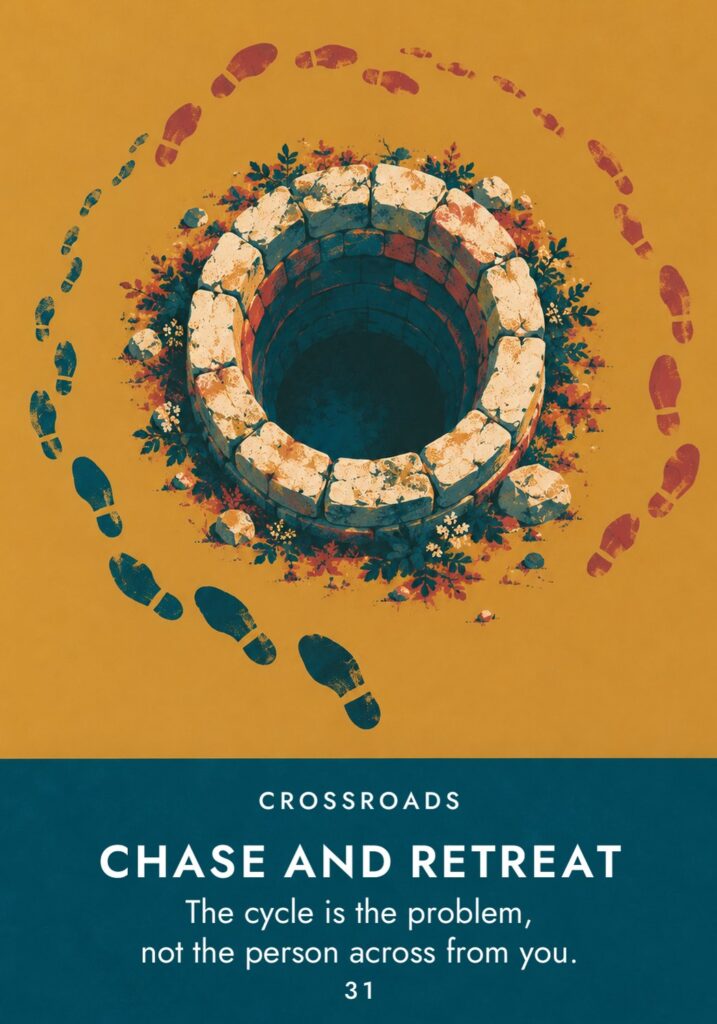
What Chase and Retreat means
Couples therapy often looks at the recurring cycle rather than looking for the one person to blame. The most familiar cycle is pursuit and withdrawal. One person presses for response, reassurance, or resolution. The other retreats from the pressure. The retreat confirms the pursuer's fear and intensifies the pursuit. See your position in the cycle without assuming both people share equal blame.
Chase and Retreat comes up for someone who has just had the same fight for the fifth time and can describe it like a dance they did not choose. They press, the other person goes quiet. They press harder because the quiet is unbearable, the other person leaves the room. By the end both are exhausted and each is certain the other one started it. I read the card as a change of subject. The person came in wanting to know who is right, and the card is not interested in that. It is interested in the shape, the loop that runs the same way regardless of what the fight is about, and in the fact that a loop has a point where one person can step differently and the whole thing changes shape.
In shadow, this becomes "it's just our cycle" used to excuse coercion, cruelty, or a repeated refusal to engage at all. The vocabulary of the dance is useful right up until it becomes a shield. When a recurring pattern includes intimidation, coercion, or fear, calling it a shared dance can hide what is actually happening. A person whose partner has not had a real conversation in a year is not pursuing too hard. The card describes a pattern between two people who are both, in their own way, trying to stay connected, and in shadow that description gets stretched over situations where one person has stopped trying, or is using the pattern as cover for something that is not a pattern at all. Not everything that repeats is a dance.
I can step out of the dance without leaving the floor.
When Chase and Retreat appears in a reading
In a reading, Chase and Retreat asks me to find the person's position, not their case. I ask them what they do first when they feel the distance open. Reach, with a question or a text or a request to talk? Or pull back, to protect something? Then I ask what the other person does in response, and I draw the loop on paper as they talk. Most people have never seen it drawn. The drawing is the reading. Once it is on the page, the question of who started it matters less than the arrows, and one of the arrows is theirs. That is not the same as saying both people carry equal weight. The loop can be real and the responsibility still uneven.
My own practice with this card is to change my arrow and leave theirs alone. If I am the one who presses, my different move is to name the pressing out loud, "I can feel myself about to chase this, and I'm going to stop and come back in an hour." If I am the one who retreats, my different move is to say where I am going and when I will be back, instead of simply being gone. Either way I change one thing, my own step, and I do not announce what the other person should do with theirs. Then I watch the loop. It does not change every time. It changes often enough that I keep trying.
Beside Take the Pause, I read the pair as the retreating partner's instruction manual: a pause with a promised return is retreat done in a way the loop can survive. Beside Inner Secure Base, the pair reads as the pursuing partner's version. Where I keep Chase and Retreat distinct from Mixed Signals is that this card requires two participants and a shape. Mixed signals can be one person being inconsistent while the other simply watches. The dance needs both feet on the floor.
One small honest step
Draw the loop on a piece of paper, your move and theirs, and show it to the other person without commentary if that feels safe, or to a friend if it does not.
Chase and Retreat in the You, Me, Us Spread
The Second Question guidebook’s three-card love reading is You, Me, Us, the classic layout with the positions changed so that none of them asks for mind reading. The first card is what I bring, the second is what their behavior has actually shown so far, and the third is what the dynamic needs for its next honest step. In each position this card tends to say:
- What I Bring. As What I Bring, the card says you are entering this connection with a position already taken in the dance, pursuing or withdrawing, and the other person is likely to be pulled into the complementary one.
- What Their Behavior Shows. As What Their Behavior Shows, it asks you to describe their move when the distance opens, what they do, not why, and to hold that as a step in a loop rather than as a verdict on them.
- What the Dynamic Needs. As What the Dynamic Needs, it points to one changed step on your side, named out loud if possible, as the thing that would give the loop a chance to run differently.
Journal prompts
- When I feel threatened in this connection, do I move closer, farther, or both in turn?
- What is the other person's move protecting them from, as far as I can honestly tell?