Use this spread when
I lay this one when the blank page is not empty so much as crowded. Everything I know about how the thing should go arrives before the thing does. This spread treats skill as the obstacle and goes looking for somewhere I am allowed to be bad, which is usually where the work restarts.
How to lay it
- Hold the question loosely. "Where am I not allowed to be bad?" works better than "Why can't I create anything?"
- Name the last thing you started and did not finish before you shuffle.
- Lay three cards face down, left to right.
- Turn one and two and write a line under each. Let the second card be genuinely unserious if it wants to be.
- Turn three. Read all three together, then choose a version you can do badly today, before you close the journal.
What each position means
- 1Where I Am Too ExpertThe competence that is getting in the way.
The standard arriving too early. Usually a skill I am proud of, applied at the stage where it has no business being applied yet. I read this card as a compliment and a diagnosis at once, because it is generally both.
- 2Where to Be a NoviceThe place you could be genuinely bad on purpose.
A material, a scale, a form, or an audience where I have no reputation to protect. It does not have to be adjacent to the blocked work. Sometimes it should not be. Being visibly a beginner somewhere loosens the grip everywhere.
- 3The First Clumsy StepThe small bad beginning you can make today.
One action, deliberately below standard, finished rather than polished. If the card points at something ambitious, I take the smallest, ugliest version of it. The point is a finished bad thing, not a promising start.
A worked example with Trickster
Here is how the spread reads with three cards from the Trickster Oracle. Suppose I have not begun a piece of work I have been circling for weeks, and the three cards are The Fool's Crown, The Wise Fool, and The Earth Diver.
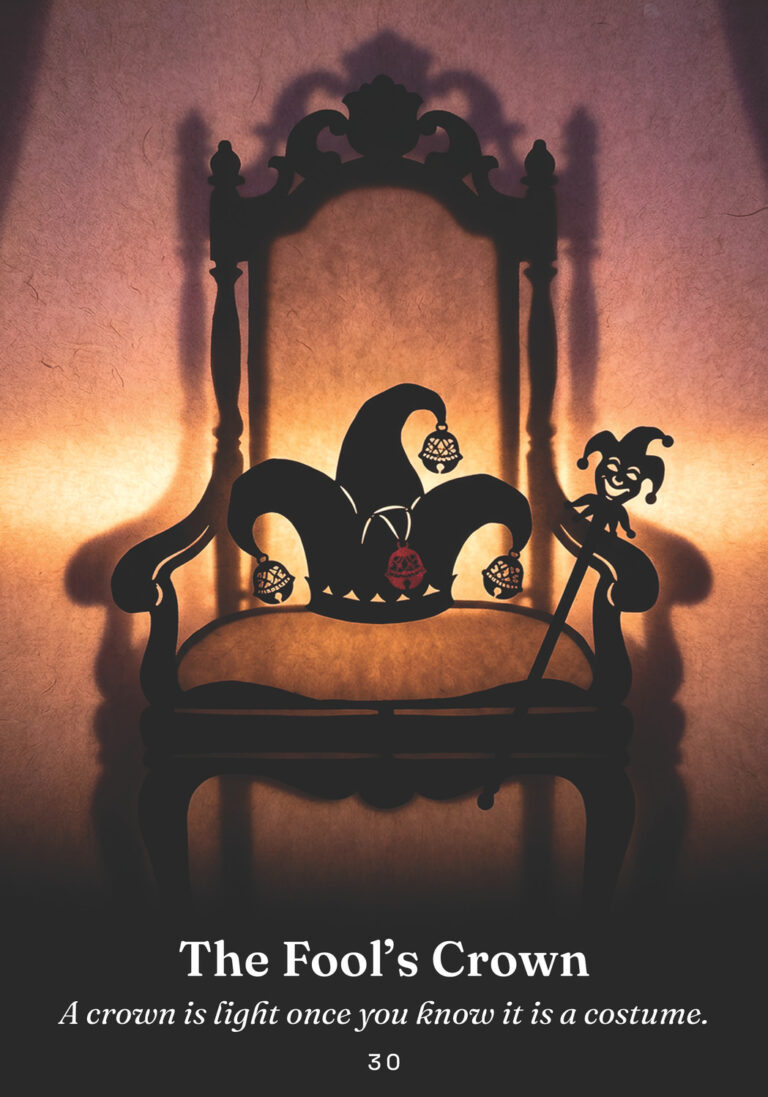
1 · Where I Am Too Expert
A crown is light once you know it is a costume.
The court fool could say what nobody else could because everyone agreed his crown was a joke. Where I am too expert is the standing I have quietly started defending, and the card points out that status is a costume that gets lighter the moment I remember I can take it off. Its shadow is worth noting too: humor used to shrink myself rather than to free anything.
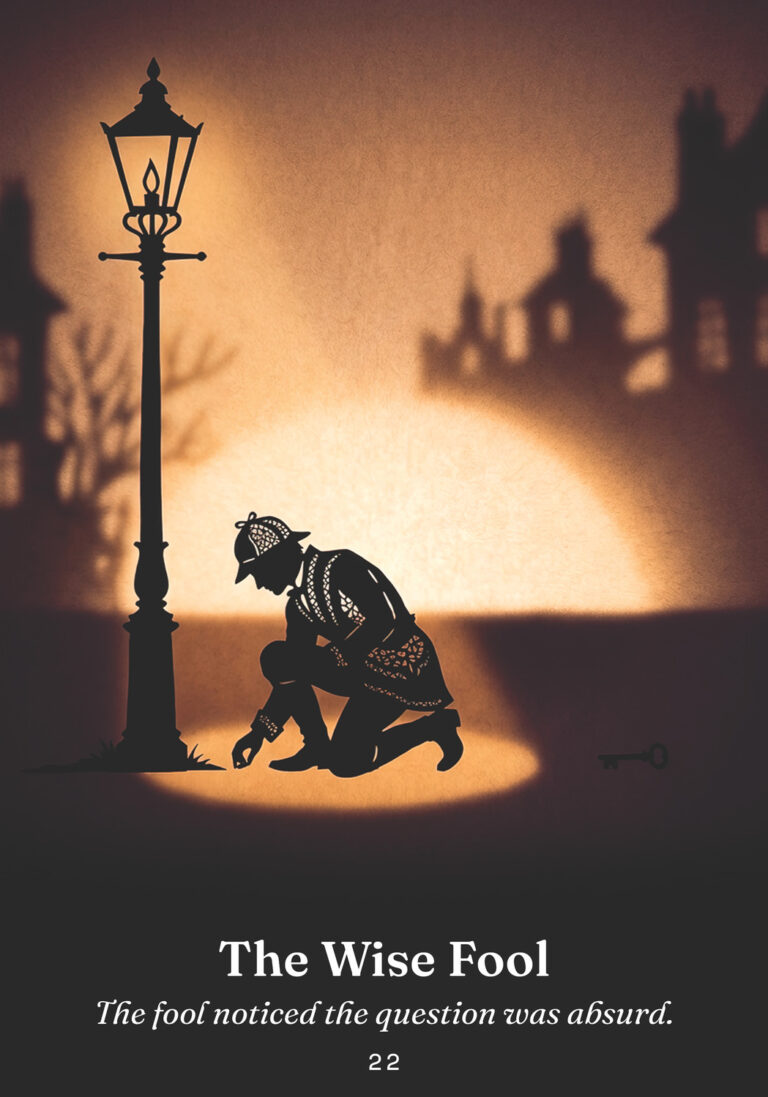
2 · Where to Be a Novice
The fool noticed the question was absurd.
Nasreddin looks for his key under the streetlight because the light is better there. The novice move is to stop searching under the streetlight. I have been working where I already know how to look competent, not necessarily where the lost thing is. The card's instruction is to laugh at the premise, and it warns off the counterfeit: playing dumb to dodge the work is not the same move.

3 · The First Clumsy Step
A world can begin again from something small.
After the flood the smallest diver comes up with a handful of mud, and a world gets built from it. The first clumsy step is that handful: begin with the small piece already in hand, and with what others have taught me. Its shadow is the one I would walk into, which is refusing help and rebuilding the same broken structure out of pride.
Read together
The block is not absence of ideas. It is a standard arriving before the work does, defended because I have started treating it as who I am. The way back in is somewhere I have no standing to protect, and the step is a handful of mud: one small finished thing, made badly, using a method I learned from someone who has done it before. Today, not once the approach is clear.
If you have been circling something for weeks, lay the three cards now. The reading tool below lays these same three positions with The Trickster Oracle.