Use this spread when
I lay this one when the voice that runs me down has been unusually loud and unusually convincing. Before I send something, before I let anyone see a first draft. The spread does not try to silence it, which never works. It treats the voice as a speaker with a history: what it says, whose cadence that is, and what the performance was built to prevent.
How to lay it
- Hold the question loosely. "What is this voice for?" works better than "How do I make it stop?"
- Write the critic's most frequent sentence, word for word. Keep it in front of you.
- Shuffle and lay three cards face down, left to right.
- Turn What It Says and read your sentence aloud in your own ordinary speaking voice. Notice what you have to change to say it that way. Then turn Who Taught It.
- Turn What It Was Trying to Save last, and read the three together as the biography of one sentence. End by thanking the voice, out loud if you can stand to, and deciding one thing yourself.
What each position means
- 1What It SaysThe critic's sentence, word for word, including the unfair parts.
I write the sentence down before I turn the card, exactly as it runs, unfair parts included. This card tends to confirm the content and then draw attention to the delivery, which is the part I usually miss. The rhythm and the vocabulary are the fingerprint.
- 2Who Taught ItThe person, house or institution whose voice that is.
The voice is older than I am, and this position asks whose it was first. Naming is not blaming. I let the name stand without a charge attached, because blame closes the reading and naming keeps it open.
- 3What It Was Trying to SaveThe danger the criticism was built to prevent, back when it was invented.
The critic is not trying to ruin me. It says the harsh thing first so that nobody else can, and once, in some room, that was a decent strategy. This card names what it was protecting, which turns the voice from an enemy into a retired guard I can thank without obeying.
A worked example with Gold in the Dark
Here is how the spread reads with three cards from The Gold in the Dark. Suppose I am wondering why the sentence "who do you think you are" arrives every single time I am about to put something of mine in public, and the three cards are The Borrowed Voice, The First Mirror, and The Retired Guard.
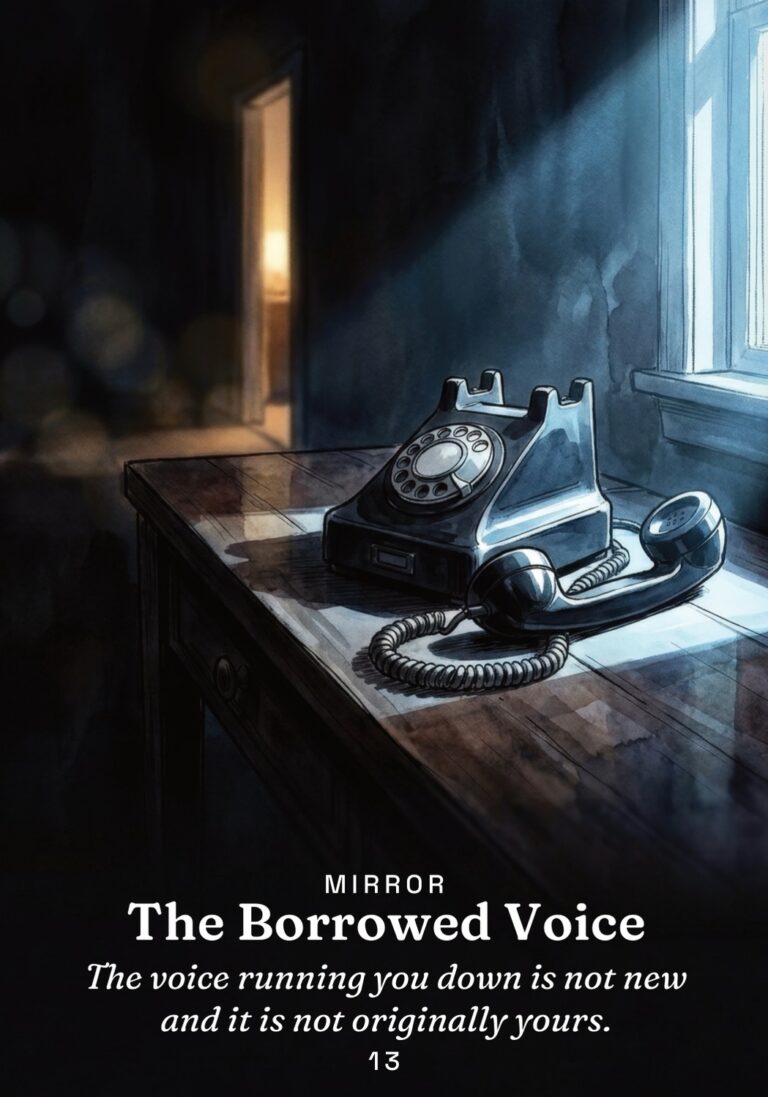
1 · What It Says
The voice running you down is not new and it is not originally yours.
What it says is the sentence I already wrote down, and the card tells me to stop listening to the content and listen to the delivery. When I read the sentence aloud in my own speaking voice, I cannot do it without softening the second half, and the card says the adjustment is the information. My voice does not say it that way.
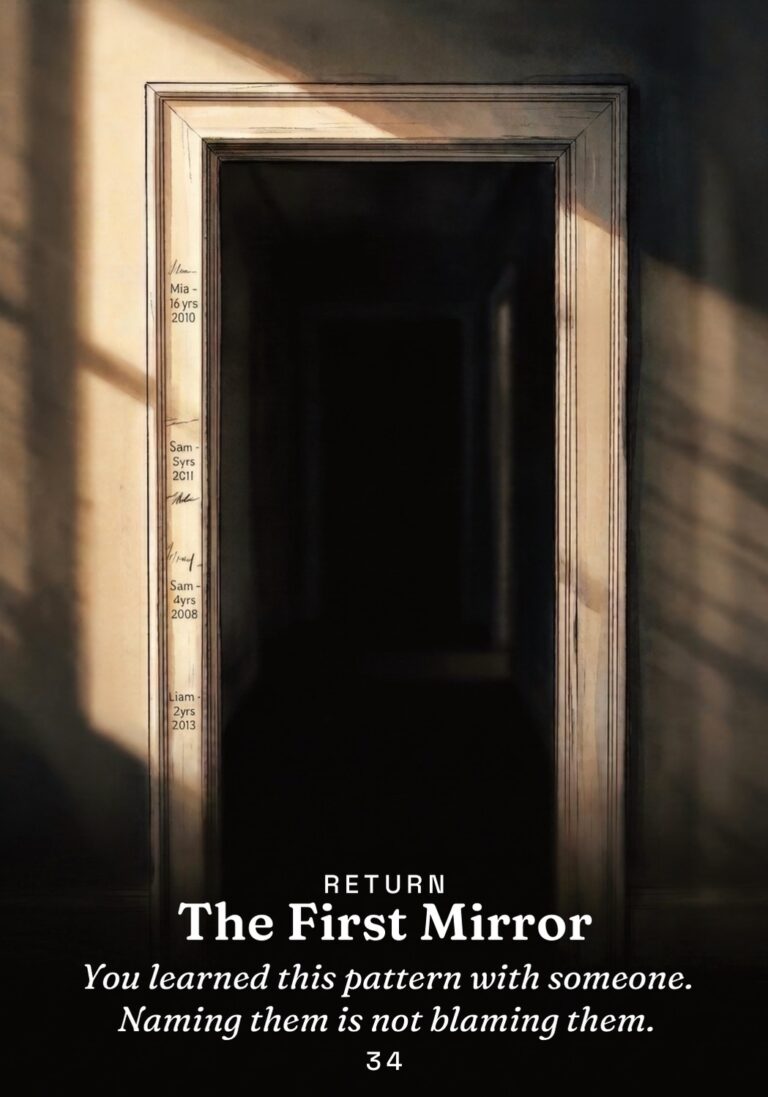
2 · Who Taught It
You learned this pattern with someone. Naming them is not blaming them.
Who taught it is a specific person in a specific house, and the card lets me name them without filing charges. A grandmother, as it happens, for whom any visible ambition was a kind of showing off that would end badly. The card frames her too: she was running her own version of this, badly, with nobody to name it for her. That is the wider frame, not forgiveness.

3 · What It Was Trying to Save
Thank it. Keep its instincts. Take back the job.
What it was trying to save was my standing in a family where standing out was dangerous, and the card gives me the terms for retiring it. I do not fire it. I keep its instincts, which are good at spotting a room where showing off really would cost something, and I take back the decision, which was never its to make.
Read together
The sentence is my grandmother's, in her cadence, built to keep a visible child safe in a house that punished visibility. It was a decent strategy sixty years ago and a bad one now. The critic keeps its job as an early warning about rooms, and I take back the decision about whether to publish. Today the answer is yes, and the note gets written tonight.
If a voice in your head runs you down and sounds like the truth, lay the three cards now. The reading tool below lays these same three positions with The Gold in the Dark.