Use this spread when
I reach for this one when the question has stopped being curious and started being a loop. Early dating, a long partnership, someone I cannot stop thinking about: the shape is the same. The familiar version gives a card to their feelings. I stopped using that position because it asks the deck to know something it cannot know. This version keeps the three seats and changes the job. The first card is mine. The second is the record, what has been done and said and kept. The third is the next honest step, which is sometimes a conversation and sometimes a decision I have been avoiding by asking the cards instead.
How to lay it
- Hold the question loosely. "What does this connection need from me next?" works better than "How do they feel about me?"
- Shuffle and lay three cards face down in a row, left to right: What I Bring, What Their Behavior Shows, What the Dynamic Needs.
- Turn the first card and write one sentence about your own side that you would be willing to say out loud to them.
- Turn the second card and list, in plain verbs, three things this person has actually done in the last few weeks. Read the card against the list, not against your hopes.
- Turn the third card and name the next step as something you could do by the end of the week: a question, a pause, a boundary, a decision.
What each position means
- 1What I BringThe quality, need, fear, or pattern you are carrying into this connection right now.
What I am walking in with, named without flinching. A need for reassurance, a habit of doing both halves, a fear from the last ending, a real and steady warmth. I do not grade it. The card is not asking whether I am good enough for this. It is asking what I would want the other person to know about my side of the table, if I were being plain.
- 2What Their Behavior ShowsNot their hidden feelings. What their actions, consistency, and responses have actually communicated so far.
The record, read like a camera would read it. Did they follow through, reach first, answer a plain question, handle a small no? This is the position where the spread earns its name. I do not use it to decode a heart. I use it to look at the evidence I already have and have been explaining away in both directions, generous and grim.
- 3What the Dynamic NeedsThe conversation, boundary, patience, or decision that would give this connection its next honest step.
The one step that is actually available. Not the outcome, the step. Often it is a question I have been rehearsing instead of asking. Sometimes it is time, a few more ordinary weeks before deciding anything. Sometimes it is a boundary or a plain no. The card points at the step; it does not promise what the step will lead to.
A worked example with The Second Question
Here is the spread with three cards from The Second Question. Three months in, the dates are good and the days between them are quiet, and I have started counting the hours between replies. Suppose I am wondering what this connection needs from me next, and the three cards are Worth Without Proof, Reciprocal Interest, and Slow the Pace.

1 · What I Bring
Your worth is not on trial. Nobody else holds the gavel.
What I Bring is a scoreboard. The card says it plainly: I have been reading my value off the gap between messages, and the gap was never built to measure that. Being chosen is not the same as being compatible, and an unanswered Tuesday is not a verdict. Its edge is the chase, the second text that explains the first, the small test slipped into a conversation. I can see two of those in the last week. That is my side of the table, and it is worth saying to myself before I say anything to him.
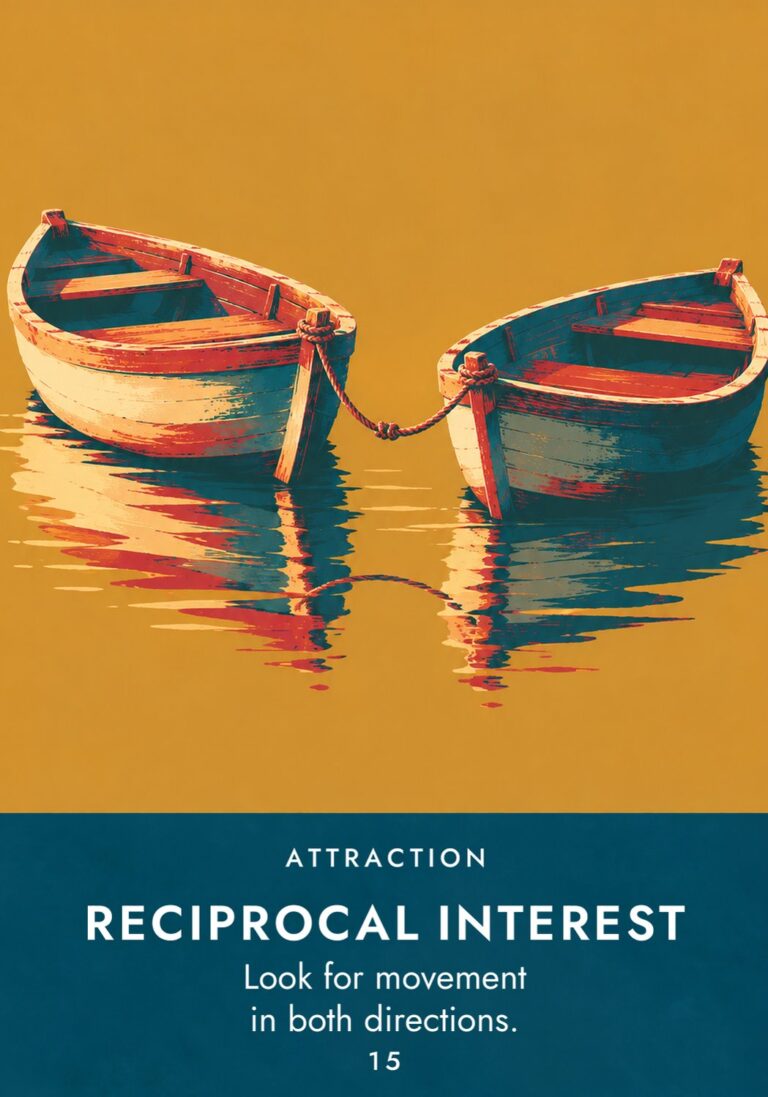
2 · What Their Behavior Shows
Look for movement in both directions.
What Their Behavior Shows is the record, and the record is not what the scoreboard said. He has planned two of the last four dates, asked about my sister by name, and answered a plain no about a weekend without sulking. He has not once reached first between dates. Both of those are true. The card asks for a pattern, not a balanced ledger, and the pattern here is warm when present and quiet in between. The edge is mine to watch: I have been filling the quiet in for him and calling it depth.

3 · What the Dynamic Needs
Let what you know catch up with what you feel.
What the Dynamic Needs is time, and one question I have not asked. Slow is not cold, the card says. Slow is clear. Three months of good dates is a weekend repeated twelve times, and a few more ordinary weeks will show me how the quiet between them behaves when I stop filling it. The one question is small, present-tense, and about the dynamic rather than his head: "I really enjoy our time together. I'd like to stay in touch a little more between dates. How would that feel to you?" The edge would be turning the slowness into a strategy, going quiet on purpose to see if he notices. That is not pacing. That is a test.
Read together
I brought a scoreboard. His behavior shows warmth when present and quiet between, with every plan kept. The dynamic needs a few more ordinary weeks and one plain question asked once. Nothing here tells me what he feels. It tells me what I have been doing with the quiet, and that the next honest step is to stop filling it and ask.
If you have been counting the hours between replies, lay the three cards now. The reading tool below lays these same three positions with The Second Question.